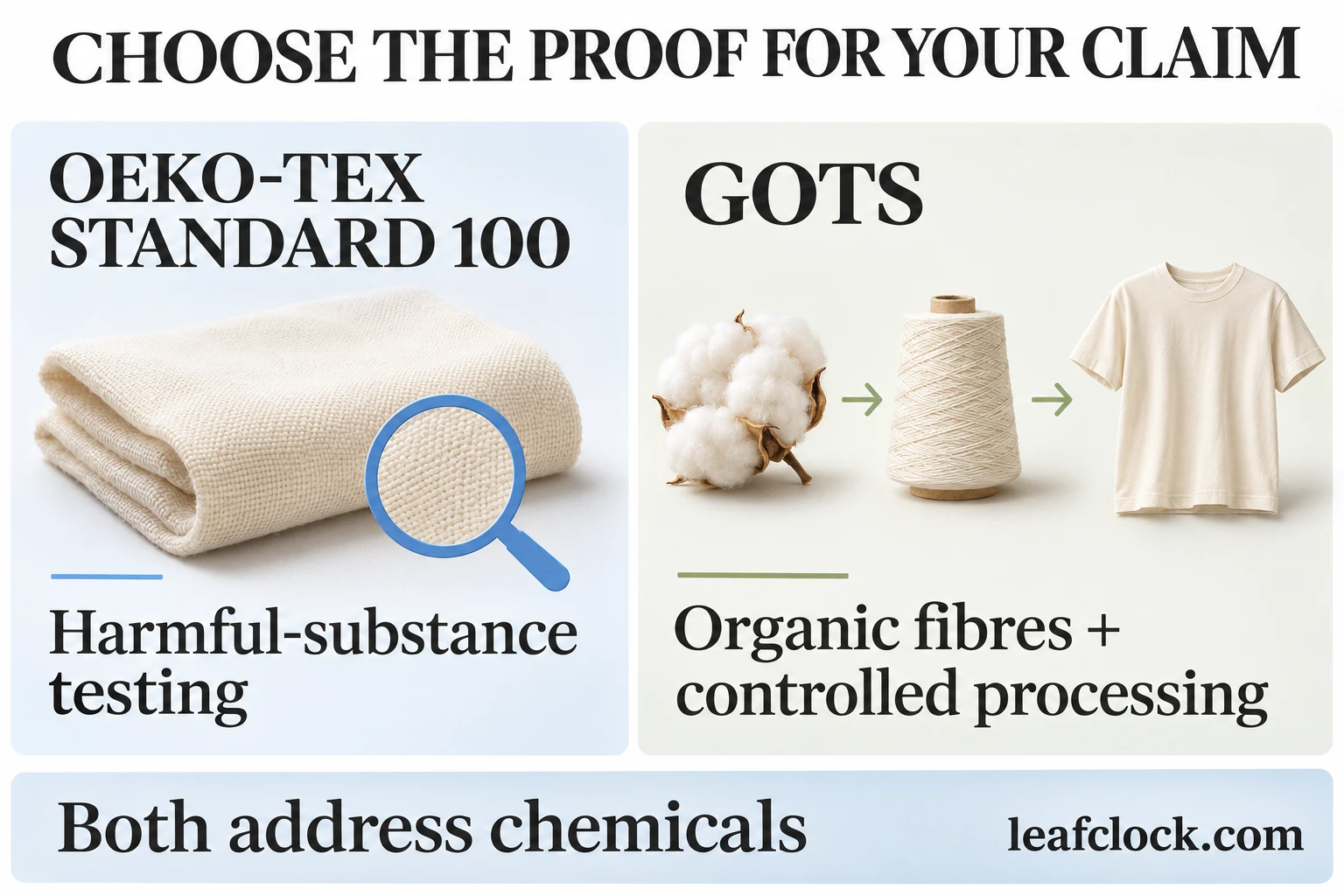
Choose OEKO-TEX STANDARD 100 for harmful-substance testing of a specified textile article; choose GOTS when you need certified organic fibres and controlled processing. GOTS has two organic label thresholds: at least 95% or 70% certified organic fibre content, excluding accessories. Match the proof to your claim and actual product. GOTS label grades · STANDARD 100
OEKO-TEX STANDARD 100 vs GOTS: the practical difference
STANDARD 100 answers a product-testing question; GOTS adds organic-fibre and processing-chain requirements, including environmental and social criteria.
| Buying question | OEKO-TEX STANDARD 100 | GOTS |
|---|---|---|
| What is the central assurance? | Covered textiles and components have been assessed against harmful-substance limits. | Certified organic fibres are processed through a certified chain under the standard. |
| Which materials can qualify? | Natural and synthetic textiles can qualify. | Products must meet an organic fibre-content grade and rules for additional materials. |
| Does it address chemicals? | Yes: substance limits and testing depend on intended use. | Yes: chemical-input restrictions, residue limits and risk-based testing. |
| Does it establish organic content? | Use separate organic certification for that claim. | Yes, with the appropriate label grade and certified product coverage. |
| Does it include processing and labour criteria? | Use the relevant separate scheme or evidence for those claims. | Environmental and social requirements are part of certification. |
| What should a sourcing team request? | Current certificate, covered article description and suitable product class. | Current scope certificate plus transaction documentation covering the purchased goods. |
The comparison concerns STANDARD 100, not every programme carrying the OEKO-TEX name. MADE IN GREEN and ORGANIC COTTON are separate programmes. Start with the exact standard printed beside the mark. OEKO-TEX standards · GOTS key features
Quick choice: for conventional or synthetic bedding with a harmful-substance requirement, request appropriate STANDARD 100 coverage. For a line sold with a GOTS organic-textile claim, require GOTS coverage through the finished product. When your retailer specifies both, obtain both for the agreed articles.
Is GOTS better than OEKO-TEX?
GOTS is the relevant choice for an organic-textile processing claim; STANDARD 100 is the relevant choice when the purchase specification requires that harmful-substance certification.
Calling GOTS “only organic” misses its chemical controls. GOTS sets requirements for processing inputs, residues and testing; its environmental and social criteria extend beyond the finished article's chemistry. A valid GOTS product certificate, however, is a different document from the STANDARD 100 certificate a retailer may explicitly request. GOTS chemical controls explained by certifier Ecocert
Use precise wording such as “tested for harmful substances under STANDARD 100” or the approved GOTS grade. Neither certification is a guarantee against individual allergies or a blanket medical-safety approval. Avoid “chemical-free”: GOTS allows qualifying chemical inputs, and both systems work with defined requirements and limits.
Read the GOTS percentage on the right basis
The organic percentage concerns fibre content excluding accessories, while accessories still have their own material and residue requirements.
For the “organic” grade, the minimum certified organic fibre content is 95%. The “made with (x%) organic materials” grade starts at 70%. These are different label grades; meeting the percentage alone is insufficient because the other GOTS requirements also apply. In-conversion grades have their own corresponding wording. GOTS 8.1, sections 2.7, 3.2 and 3.3
For example, a fabric declared as 80% certified organic cotton clears the lower percentage threshold, not the “organic” grade threshold. Its remaining fibres, processing and certification still need approval. A sewn label excluded from the fibre calculation still needs to meet the applicable accessory requirements. Ask the certifier how your actual construction is classified before approving a label claim.
Version note, checked 14 November 2026: GOTS 8.1 was released on 22 June 2026. Its implementation date is 1 March 2027, with early adoption permitted during the transition. Confirm the applicable version with the supplier's certifier; the latest published version and the version currently applying to a particular certificate can differ during transition. Official version update · Standard introduction
Match STANDARD 100 to how the textile is used
Choose the product class from intended use and skin contact, not the shop category.
The official scheme has four classes: Class 1 covers babies and children up to 3 years; Class 2 covers direct skin contact; Class 3 covers articles without direct skin contact; and Class 4 covers decorative materials. Bed linen is a Class 2 example, whereas curtains are a Class 4 example. STANDARD 100 certificates are issued for one year. Check current validity as well as the class. Official classes and certificate term
For baby clothing, ask for the appropriate baby-article coverage on the actual garment. For adult sheets, request direct-skin-contact coverage. A curtain-fabric certificate is a reason to ask another question, rather than approve the same cloth for sheets. Our STANDARD 100 product-coverage checklist explains the garment and component checks in more detail.
Check the product before accepting the certificate
A successful database lookup is the beginning of a product match, not the end of purchasing approval.
For a retail purchase, find the label or licence number, use the official checker, and compare the result with the product listing. On a GOTS product label, check the label grade, certification body and certification number alongside the logo; the certifier approves the label use. GOTS labelling Ask the seller which exact item is certified when a website displays a general supplier badge. For a brand order, keep the following checks with the approved sample and bill of materials.
| Check | What to compare | When to hold approval |
|---|---|---|
| Identity and status | Certificate number, holder's legal name, issuer, validity dates and current official result. | The number fails, the document is expired, or the holder differs without an explained supplier relationship. |
| Exact article | Product category, article or material references, composition, colour and finish where these define coverage. | The document describes yarn or fabric while the claim concerns a finished garment. |
| Components and processes | Main fabric, thread, print, coating, adhesive and trims against the certified description. For GOTS, check relevant facilities and processing activities. | A new print, label or outsourced process falls outside the confirmed coverage. |
| Purchased goods | Purchase order, invoice and delivery details. For GOTS B2B goods, reconcile the transaction certificate with the covered products and quantities. | The supplier offers only company-level certification for an order-specific claim. |
| Public wording | Product description, packaging and mark artwork against the scheme's applicable labelling rules. | Marketing proposes a broader claim than the certified article supports. |
Enter the certificate number or follow the QR route in OEKO-TEX Label Check. For GOTS, use the official certified suppliers database, inspect the current scope certificate and resolve discrepancies with its issuing approved certifier. Save the check date and the documents used for the decision.
GOTS scope certificate vs transaction certificate
A scope certificate identifies a certified entity and its covered products and activities; a transaction certificate connects certified goods to trade and shipment details.
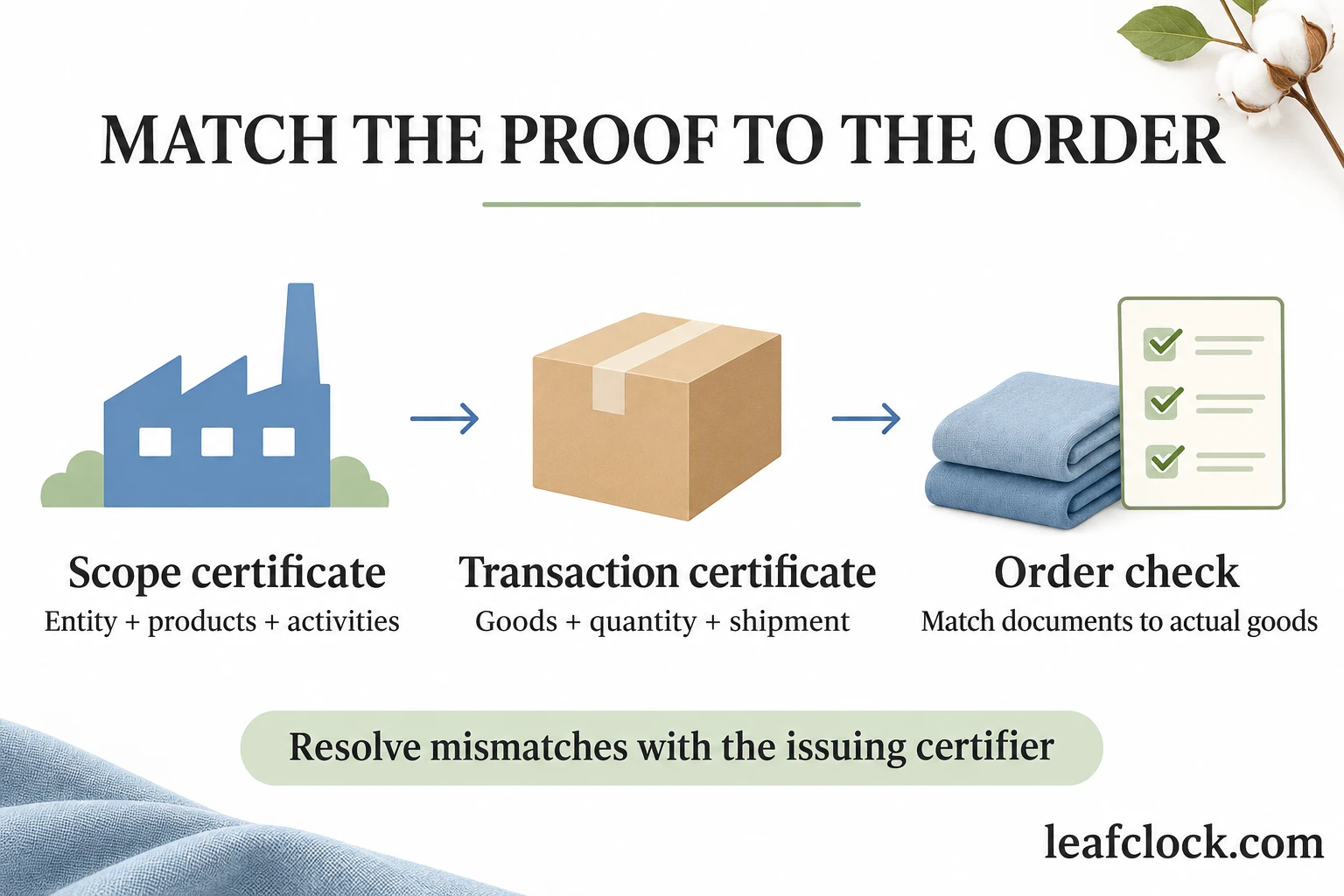
Use the scope certificate to assess whether your supplier is certified for the work and product category you need. Use the transaction certificate to check the purchased goods, including seller, buyer, product description, quantity and shipment references. Reconcile it with invoices and delivery records, and ask the issuing certifier to resolve any mismatch. Use the database to locate the entity, then use its current scope and transaction documents to check your purchase. GOTS supplier database · Transaction certificate definition
For a consumer buying a finished item, start with its approved product label and seller's product-specific explanation. The B2B transaction-document trail is a supply-chain purchasing task; a shopper should not need to reconstruct the whole factory file.
Two purchasing decisions that catch coverage gaps
Approve the product you are ordering, and reopen the relevant check when its construction changes.
Organic-cotton T-shirt with a new neck print. The supplier provides a GOTS certificate for the cotton fabric. Ask for finished-product coverage and confirmation that the printing and garment-making steps are included in the certified chain. Hold the GOTS hangtag artwork until the finished garment and intended labelling are approved. Certified fabric alone does not make the finished garment GOTS-certified. GOTS product labelling rules
STANDARD 100 bedding with an added indicator label. The fabric certificate matches the sheet fabric, but the brand adds a printed or heat-transfer component. Give the certificate holder the updated construction, including the carrier, ink or coating and adhesive. Confirm whether the finished article remains covered and whether additional assessment is needed before using the finished-product claim. The scheme's modular approach can use existing component certification; coverage of the final article still needs confirmation. STANDARD 100, sections 4.3 and 5.10
Keep the certification review separate from performance questions such as bond strength or readable print after laundering. Use our OEKO-TEX vs SGS document guide when deciding which certificate and test report to request.
For brands adding a visible replacement cue
Material-compliance documents address the covered construction; a Leafclock indicator communicates a configured use-stage cue on the product.
We customize the indicator for target wash-and-sun-dry or wash-and-tumble-dry cycles, or an intended replacement interval, using your product's care and usage conditions. The wearer compares the changing functional area with its reference area. That gives your brand a visible prompt to explain in packaging and care instructions.
Include the chosen heat-transfer or sewn carrier in the garment's component review. Use the textile-label certificate checklist for the material documentation, then share your product, care routine and target replacement point to discuss a suitable sample configuration.
Frequently asked questions
Can a product have both OEKO-TEX STANDARD 100 and GOTS?
Yes. A product can meet both schemes when each certification covers the relevant article. Ask for the separate documents and match them to the same product and construction. Dual certification is useful when the buyer requires both organic processing assurance and a specific STANDARD 100 certificate.
Does OEKO-TEX STANDARD 100 mean organic cotton?
No. STANDARD 100 concerns harmful substances in the covered article and can apply to natural or synthetic textiles. For an organic claim, check the separate organic certification and its product coverage. Read the full programme name because OEKO-TEX also operates a distinct ORGANIC COTTON programme.
Does GOTS mean no chemical testing is needed?
No. GOTS includes chemical-input controls, residue limits and risk-based testing requirements. A sourcing team should agree any additional retailer tests against the actual purchase specification. Use the certification for the claims it supports and order any separate performance or market-specific testing the product needs.